HRI was an idea that started in 2015, became a reality with the support and vision of the Phillips Foundation along with UNC Greensboro and a dedicated team of community-based leaders. Since then, HRI has developed hundreds of resources and programs to strengthen relationships of all kinds.
In this video, HRI Director Dr. Christine Murray provides a brief introduction to the history of HRI and its evolution throughout the years. We’re excited to share a little bit about our history and the history of Healthy Relationships Week!
Healthy Relationships in Older Adulthood: Navigating the Terrain
By Evelyn Smith, MA, LPA, Health Promotion Coordinator at the Piedmont Triad Regional Council Area Agency on Aging
No matter a person’s age, there is a desire for connection with others.
Researchers describe this as a basic human need. For some older adults, these connections may be lost for a number of reasons. These include the passing of a spouse or friends. Friends may move into care facilities or into the homes of their adult children. When older adults retire from their jobs, this can often weaken or end the bonds they had with coworkers. Health issues or driving difficulties may limit the amount of independence and access to social events an older adult previously had. Even though there are challenges, there is good news for older adults. There are many ways to establish or reestablish social relationships with others.
The first step is to think about the kinds of social relationships that are desired. What do you want? Is it to be able to talk with family on a regular basis? Are you looking for meaningful group activities? Do you just want someone to check on you now and then? Do you desire a romantic relationship?
Below are some ways that you can become engaged in different relationships:
With Family:
Contact your relatives and tell them that even if you seem to be doing okay, you really want and need them to call you on a daily or weekly basis. Share this request with multiple family members if possible. This may not always happen as often as you like, but you can work to spread your circle even wider to others beyond family members.
Ask if you can listen to the grandkids reading for their schoolwork. This helps you and them.
Offer to call them instead of waiting for their call.
If you do not have family you can turn to, consider reaching out to neighbors, joining an online support group for older adults, or you may contact your local senior center. Many of them offer daily calls to seniors who would like contact.
With Friends:
Connect with your homeowners association and ask if there are any opportunities for connecting with neighbors.
Do some research to track down old friends. If you are not good with the computer ask a family member or friend for help.
For those who are local, contact your Area Agency on Agency by dialing (336) 904-0300. They can inform you about virtual and in-person classes, and services for groups and individuals that are at no cost to you.
Volunteer as a Pen Pal. There are groups that can connect you to pen pal opportunities with military members, older adults and others.
With Potential Romantic Partners
Make a decision about what you want in a relationship.
Talk it over with a trusted family member or friend.
If you choose to use online dating platforms, be sure to first identify a trusted safety buddy to inform about all of your online dating activity. Let them know the date, time and location of any planned meetings, as well as the person’s name and other details.
Reach out to known networks (church, community organization, recreational facilities) and ask about opportunities to meet others.
Join groups that share an interest (music, gardening, reading, quilting).
Avoid sending money, gifts or financial information to someone you have met online.
Ask a friend to join you for the first in person meeting with an online date.
Be open but wise.
All of these strategies to connect require effort on your part. If you do not feel up to doing this, you can have someone to be an advocate to assist you. If you need expert support, consider meeting with a therapist who can provide a safe space for you to talk about aging, loneliness, and what you want to do at this stage in your life. Counseling is not just for the persons who are living with a mental health diagnosis. Counseling is a resource for those who are worried or wondering, wounded or wishing, the wise or the wisdom seekers. Counseling is available online or in person with social distancing and safety practices. Click here for an HRI resource on finding a counselor to help with relationship and family challenges.
Getting Started in Relationships:
Once you find people to engage with, look for some basic elements and gut checks of a healthy relationship.
Is communication between the two persons valued and encouraged?
Are the thoughts and feelings of each person respected even if there is disagreement?
Does the relationship allow adequate room for each person’s individuality without demanding that one person always mold to the wishes of the other?
Does the relationship add to your life and fulfillment rather than taking away from it?
Does the relationship allow you to maintain connections to family, friends and activities you engaged in before the new relationship started?
Does this person connect you to the rest of their world (family, coworkers, friends)?
Are your “No’s” respected?
Is there a balance of give and get or is one person mostly taking without giving?
Does this relationship feel good to your intuition or are there silent alarms?
Are you personally growing in this relationship of just going?
This is not a one-time checklist. Return to it often. You can navigate the terrain of relationships as long as you keep your eyes as open as your heart.
For more on this topic, check out this previously recorded video of HRI Program Director, Christine Murray, and author of this article, Evelyn Smith, as they discuss insights and strategies to maintain healthy relationships in older adulthood: click here.
We’re closing out our teenage resource spotlight during Healthy Relationships Week 2021 with a list of resources focused on helping teenagers strengthen relationships of all kinds and learn healthy relationship skills. Check out the list below for HRI Resources, along with Greensboro Parks & Recreation resources as well!
Healthy Relationship Video Series for Teens: short video clips highlighting important healthy relationship concepts
We’re grateful to Greensboro Parks & Recreation for their partnership with HRI during Healthy Relationships Week! There are many resources available for teenagers through Greensboro Parks & Recreation.
Day 5 of Healthy Relationships Week: Helping Teens Become Better Communicators
One of the most important skills that adults can teach teenagers is how to communicate effectively. When teenagers know how to communicate their needs and listen to others, it helps them set the foundation for healthy, happy, and safe relationships later on in life. In this short video developed by HRI, we share important tips to help teenagers fine-tune their communication skills. This video can be widely shared amongst teachers, educators, providers, parents, and anyone else working closely with teenagers.
Check out our short HRI clip on Healthy Communication Tips for Teens here.
We’re grateful to Greensboro Parks & Recreation for their partnership with HRI during Healthy Relationships Week! There are many resources available for teenagers through Greensboro Parks & Recreation.
HRI is here to help families parenting teens to build happy, healthy, and safe relationships! Our goal is to meet families parenting teenagers where they are and offer resources and information to help take the next steps in strengthening their relationships.
We’re excited to premiere our first short video clip specifically for teenagers! In this video, HRI Program Coordinator, Camila Dos Santos, discusses the characteristics of healthy relationships of all kinds.
We hope that this resource will be helpful for parents, providers, educators, mental health professionals, and anyone else working with teenagers! To view the short clip on Youtube, click here.
We’re grateful to Greensboro Parks & Recreation for their partnership with HRI during Healthy Relationships Week! There are many resources available for teenagers through Greensboro Parks & Recreation.
An important aspect of helping teenagers build healthy relationships is to help them understand and recognize red flags of unhealthy or abusive behavior.
In this short clip, HRI Program Coordinator, Camila Dos Santos, highlights the common red flags in teenage relationships. We hope that this resource will be helpful for parents, providers, educators, mental health professionals, and anyone else working with teenagers! To view the short clip on Youtube, click here.
The National Domestic Violence Hotline states that even 1 or 2 red flags can indicate an abusive relationship. Please visit their website for more information and resources for abusive or violent relationships.
Learn about the Abuse is Never Okay Campaign in Guilford County, a collaborative effort to end interpersonal violence and relationship abuse in Guilford County and beyond.
We’re grateful to Greensboro Parks & Recreation for their partnership with HRI during Healthy Relationships Week! There are many resources available for teenagers through Greensboro Parks & Recreation.
Regardless of our relationship status, we can all benefit from a little self-care.
Through the Healthy Relationships Initiative, we offer many resources to support relationships of all kinds, including the relationship with yourself! To celebrate the third day of Healthy Relationships Week, we’re sharing a list of resources to help you take care of yourself today:
“A good marriage isn’t something you find. It’s something you make, and you have to keep on making it.” – Gary Thomas
To celebrate the second day of our 5th Annual Healthy Relationships Week, we’re highlighting partner relationships today by premiering two videos throughout the day featuring relationship experts as they share their insights into how young married couples can set the tone for a healthy marriage. Learn more about how to tune into these videos here.
But, we also wanted to highlight all marriages today with a little reminder and motivation to do something intentional to strengthen your relationship with your spouse today. Taking just a moment to express gratitude, show affection, or extend a compliment can set the tone for a healthy and happy Valentine’s Day week and beyond!
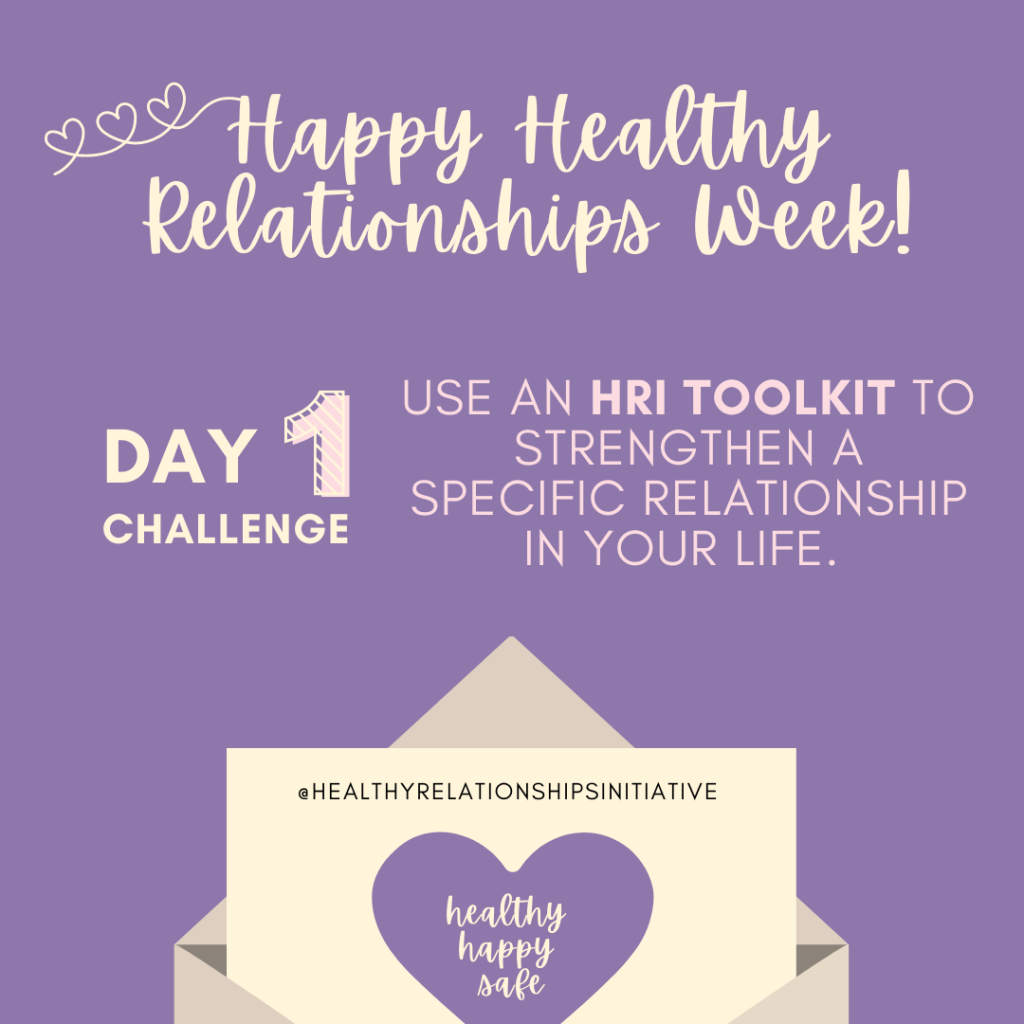
Today marks the first day of our fifth annual Healthy Relationships Week!
For the fifth year in a row, we’re offering 7 days of consecutive resources to help you strengthen all of your relationships, focusing on one particular relationship each day of the week. Today, we challenge you to use one of our HRI toolkits to help strengthen a particular relationship in your life.
Each HRI Toolkit offers three sets of resources. First, Reflectresources provide self-reflection activities to examine your beliefs and views toward relationships. Second, Connect resources offer Conversation Starters to help guide discussions with others in your life to better understand one another. Third, the tools in the Buildsection offer tip sheets that address several common elements of different types of relationships.
No matter what’s going on in your life or in the world, one thing you can do to make it brighter is to practice gratitude every day. Having an understanding of what gratitude means to you can help you begin to practice it in your daily life.
The Oxford Languages describes gratitude as “the quality of being thankful; readiness to show appreciation for and to return kindness.” How would you define gratitude? What does that look like in your life?