If you’ve had a lot of challenges in past relationships–or even in your current relationships–know that you aren’t destined to repeat the mistakes and hurts of the past. Be intentional about building new relationship skills to strengthen your relationships from today on!
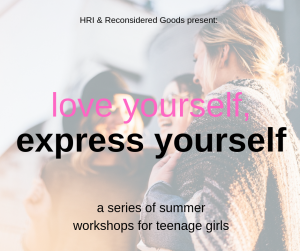
Reconsidered Goods and UNCG’s Healthy Relationships Initiative are partnering together this summer for Love Yourself, Express Yourself, a workshop series designed for teenage girls who want to learn more about strengthening healthy relationships.
Do you enjoy crafting and getting to know other people your age? Are you looking for something fun to do with your girlfriends? Join us at Reconsidered Goods for monthly art activities focused on fostering self-care practices, self-expression through the arts, strengthening leadership skills and setting effective goals. Workshops are $10 each with all materials provided. All workshops are for participants ages 13-19 and take place at Reconsidered Goods. Please contact us at laura@reconsideredgoods.org for scholarship information.
Click here to register for the July 10th workshop.
Click here to register for the August 14th workshop.
Another key element in being a healthy relationship role model to kids is to practice forgiveness. Forgiveness is a powerful relationship tool that can promote growth, healing, and connection!
When your children make mistakes, use those moments as a learning opportunity and model forgiveness. Talk to your kids about why their actions were hurtful, and be sure to express that you love and forgive them. This is a wonderful opportunity for your children to learn the healing power of forgiveness for both the person being forgiven, as well as the person doing the forgiving.
Check out our“Forgiveness”series for more information!
An important part of creating and maintaining healthy relationships involves owning your mistakes and apologizing. When you recognize your role in hurting someone’s feelings regardless of your intent, you can work towards repairing the relationship and building an even stronger connection.
When you make a mistake or do something to hurt or upset someone, it is important to take ownership of your actions and apologize. This is especially important to do in your relationship with your child, as it will show them what it looks like to take responsibility for their actions and mistakes and how to apologize and work towards repairing the relationship. Remember, a simple, “I’m sorry,” can be a big step in developing stronger, healthier relationships.
An essential part of being a healthy relationship role model is owning your emotions. This means taking responsibility for your emotions and reactions and expressing your feelings in a healthy way.
An important part of modeling healthy emotional expression is teaching your kids that it is okay to get upset or feel afraid, while also showing them how to express these emotions in a healthy way. This may look like communicating with your kids when you are upset or angry with them and saying that you need to take a break to calm down. By modeling this behavior in your relationships with your children, they will have a better understanding of how to respond when they feel upset with you, other adults, or their friends.
When you take ownership of your emotions and show that only you can control what you feel, you are teaching your kids to take responsibility for their feelings and reactions, which will help them develop happy, healthy, and safe relationships in the future.
Active listening is a key element in healthy relationships and an important skill for kids to learn to have healthy relationships of their own. You can teach active listening by modeling it in your own relationships and having conversations with your kids about what it means to be a good listener.
What exactly does active listening look like? Active listening means giving the other person your full attention and trying your best to understand what they are saying. Active listening does not involve thinking about your own response to what you are hearing, and instead focuses on seeking clarification and deeper understanding by reflecting back what you hear or asking questions when you don’t understand something.
In addition to modeling active listening to your kids, we encourage you to talk to your kids about how to be a good listener. Here are some active listening skills that you can work on with your kids:
Maintain eye contact. When you keep eye contact in a conversation, it can be easier to stay tuned in and follow what the other person is saying. This also helps the other person feel heard during the conversation, creating a safe and supportive environment. Though eye contact can be beneficial in active listening, it is also important to note that this is not easy for everyone and your child’s developmental needs should be taken into consideration if this feels uncomfortable or challenging for them.
Don’t interrupt. Be sure to let the other person finish what they are saying before you respond. This can help avoid assumptions and miscommunication.
Ask questions. By asking specific questions about what the other person is saying, you can show that you are listening while also seeking clarification to ensure you understand their message.
Reflect what you heard. A great way to ensure that you understand what the other person is saying is to repeat back in your own words what you heard. This also gives the other person a chance to correct you, promoting clarity and understanding in the conversation.
We encourage you to model and practice these active listening skills in your relationship with your child!
An important part of being a healthy relationship role model for kids is to practice healthy communication. This includes treating your child and other adults in your life with kindness and respect and interacting with them using healthy communication skills. Another key piece in promoting healthy relationships is talking to your kids about what healthy communication looks like and teaching them important skills to help them have healthy interactions with the people in their lives.
One step in practicing healthy communication is to avoid using blaming “you” statements when handling conflict, and instead, using “I” statements. By using “I” statements your kids will be able to observe positive examples of communication and conflict management and learn how to communicate using emotions. Not only is it important to model these behaviors, but it is also important to talk to your kids about why using “I” statements, as well as other healthy communication skills, can help them have healthier and more meaningful relationships.
Another great way to model healthy communication is to acknowledge and respect your child’s feelings. This will show them that it is safe to communicate how they feel, which will enable them to share their feelings and ideas with others in the future, while also respecting the other person’s opinions and emotions. An important part of encouraging your child to share their feelings is to help them develop a vocabulary of feeling words to express their emotions more effectively. By teaching children the importance of sharing their emotions and respecting the emotions of others, they will be able to foster healthy relationships and facilitate positive communication throughout their lives.
Tell your kids how much you love them every day. By expressing your love for your children openly and often, you are teaching them that they are worthy of love. Not only is it important to verbally express your love, but it is also important to show it through your actions. This will be unique to each family, but it may look like physical affection or small acts of kindness. Open and readily available expressions of love and affection not only show your children that they deserve to be loved, but they also teach your children the importance of communicating their emotions to the people they care about. It is also important to model expressions of love by communicating these feelings to others you care about, such as family members, friends, and romantic partners. This can help your kids understand how love shows up and is communicated in different types of relationships.
It’s safe to say that parents and caregivers want what is best for their children. They want them to achieve their goals, have dreams, and grow up to be happy, healthy adults, and a big part of this involves being able to foster and maintain happy, healthy, and safe relationships throughout their lives.
The most impactful way to teach your kids how to have healthy relationships, is to start at home. Your relationship with your child is a powerful tool to model healthy relationship behaviors, which they can develop and carry with them throughout their lives. You can teach your child essential healthy relationship skills, such as healthy communication, effective conflict management, and active listening, and problem-solving through your behaviors and interactions.
When thinking about what it means to be a healthy relationship role model, the phrase, “little eyes are always watching,” comes to mind. This phrase rings true, especially when thinking about how your actions and behaviors influence the way your child behaves and interacts with others. Children often model what they see, so it is important to be intentional about modeling healthy relationship behaviors not only through your interactions with them, but also through the way you treat and interact with other people in your life.
Here at HRI, we are passionate about equipping people in our community with the knowledge and skills to be healthy relationship role models to the children in their lives. Throughout the next week, we will be sharing tips to help you be a healthy relationship role model to your own kids, as well as children you may interact with through work, family gatherings, and more!