Many frontline workers during COVID-19 are working extremely long hours, only to feel exhausted when they arrive home. Whether the essential worker in your life lives with you or not, supporting their loved ones during this time is a great way to show your solidarity, while also supporting those who are directly impacted by the pandemic.
By helping essential workers and their loved ones with the logistics, such as by sending them groceries, doing their laundry, or walking their dog, you can help them manage the other aspects of their life during a time of chaos. When thinking of logistical tasks that you can help with, it is important to keep in mind that staying safe and adhering to social distancing and other safety guidelines is most important during a time like this.
If you are unable to safely support the families and loved ones of essential workers with logistical tasks, reaching out and staying connected is an excellent way to give back and show your support. Check in and ask them how they are doing, or if there is anything you can do to help during this time. Other ideas to reach out can include sending a text or a picture or sending a thoughtful gift.
When we support the loved ones of essential workers during this time, we create a feeling of bonding and connection that can help us all overcome the challenges of an uncertain future.
With many professionals working from home as a result of the COVID-19 pandemic, setting boundaries and finding the balance between work and other priorities can be a challenge. This session, in partnership with Healthy UNCG, will address how to set boundaries for working from home and will be presented by the Program Coordinator of the Healthy Relationships Initiative, Camila Dos Santos. This webinar will be presented in a Zoom format, and participants will receive information on how to connect upon registering.
To register for this free webinar, please click here.
The recording of this presentation can be found here in our HRI E-Learning Center.
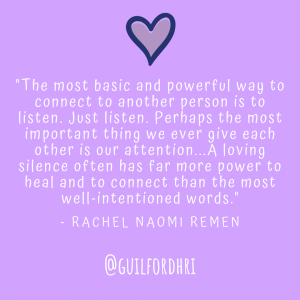
It is no secret that during tough times, one of the most important things we can do is stay connected with our loved ones. But, sometimes, we get so caught up in the act of staying connected, that we forget to actually be connected and listen carefully to one another.
When reaching out to an essential worker in your life to check in, make sure you are listening attentively to what they say. Some signs of attentive listening include:
Paying attention to the speaker: Actually listening to what they say instead of preparing your response or thinking about what you want to say.
Withholding judgment: During highly stressful times, the last thing people need is to feel judged for expressing themselves honestly. The fact that essential workers are facing a deadly virus every day can lead to a rollercoaster of emotions and thoughts, and it is important that they feel comfortable expressing themselves to loved ones without fear of judgment or repercussion.
Avoiding interruptions: Be sure to let them finish what they are saying. This can help avoid assumptions and miscommunications and can give the other person a chance to vent or get it off their chest. Sometimes, the best thing we can do for someone is allow a safe space for them to “get it all out.”
When we listen to our loved ones attentively and without judgment, we create a safe space in the relationship for open communication and sharing. This is especially crucial during a time of chaos and uncertainty because it keeps us in tune with one another and aware of our loved ones’ needs during this time, but it also helps to set the foundation for a healthy relationship beyond the pandemic.
Gratitude is more than just being thankful – it is showing that thankfulness in measurable ways. Gratitude not only helps us stay in tune with what makes us happy and what motivates us, but it is also a great way to show others that you see them and are there to support them, especially during challenging times.
While showing gratitude can look different for everyone, below are some measurable ways to demonstrate your gratitude for an essential worker in your life:
Create a sign and display it to show your loved one and others that you support and love someone who is in the trenches during the pandemic.
Send flowers or a thoughtful card to let them know you are thinking of them.
Donate a meal or a sweet snack for them to enjoy at the end of a long day. If you are financially able to, consider sending meals to their team or coworkers for them to enjoy together while they take breaks from their demanding days, or consider setting up a community meal train.
Show kindness. Kindness is one of the most powerful forms of gratitude that we can show. During these stressful times, a small act of kindness can go a long way into helping someone overcome a tough day or a difficult moment. Giving a compliment, providing a listening ear, or giving a hug (if you can and it is safe to do so) can really transform a person’s day, especially now.
Don’t underestimate the power of saying thank you. Saying thank you regularly will show the essential worker(s) in your life that you are thinking of them and that you are grateful for what they do each day.
When we take the time to show our gratitude to essential workers during the pandemic, we are showing our solidarity during a time when it matters most. Take some time today to intentionally show an essential worker in your life that you are grateful for them. You may find that it brightens your day as well as theirs.
The COVID-19 pandemic has upended the lives and routines of people all over the world. However, while most of us are staying home to slow the spread, there are many who wake up each day and face this pandemic head on. This HRI series will provide you with a new tip each day this week to help you find ways to support essential workers during the pandemic. Today’s tip is to show your support to essential workers by staying home.
Perhaps the most impactful way to support essential workers during the pandemic is to stay home and follow all social distancing guidelines. When we stay home, we help to keep everyone safe by preventing or slowing the spread of the virus in our communities. However, you are also sending a message to the essential worker(s) in your life – a message that you value and respect what they do, and that you will do your part by staying home and abiding by social distancing guidelines.
By staying home, you are not only helping to keep your community healthy, you are also supporting the people who do not have the choice to stay home.
Listening is one of the best ways for us to connect and show our love and support for one another, especially during life challenges. Take time today to really listen to what your loved ones have to say. Be present. Be open. And be kind.
Each session will feature an expert who will answer questions that are submitted in advance. Questions may be submitted directly to Camila Dos Santos at c_dossan@uncg.edu or by messaging either the YWCA HP or HRI on Facebook. All sessions will be facilitated by the Director of the Women’s Resource Center at the YWCA HP, Priscilla Bravo.
As your kids get older and more mature, your conversations about consent can cover more complex topics. The pre-teen and teen years are a good age to discuss topics like coercion and manipulation, while also introducing information about building healthy relationships with friends and dating partners. At this age, it’s also essential to continue teaching kids how to set healthy boundaries with their peers, as well as with romantic partners as they begin to date. Talking to your pre-teen or teen about consent will help them learn important, lifelong skills to develop happy, healthy, and safe relationships of all kinds! Check out these tips to help you continue the conversation of consent with your kids
Talk about what consent is vs. isn’t. One of the most important things to help your child understand is what consent is versus what it isn’t. This will help set the stage for later conversations about other topics, such as healthy boundaries, peer pressure, and coercion. Help your pre-teen/teen understand the following:
Consent is voluntary. It is freely and willingly given and is not manipulated or forced. Consent cannot be given when someone is under the influence of a substance (i.e. alcohol).
Consent is mutual. Both people in the relationship give clear verbal agreements about what they want. Consent cannot occur if only one person is willing or if it is unclear whether or not someone is giving consent.
Consent is ongoing. It is important to ask for consent every time, regardless of whether or not someone has consented to something in the past. Just because someone was okay with something in the past, does not mean you can assume they are always okay with it.
Consent is mandatory.It is critical to always seek consent. Consent is never optional!
Consent is enthusiastic! Both partners should be excited and show enthusiasm. If someone sounds apprehensive or unsure, it’s not consent.
Consent is reversible. You can change your mind at any time, and you can say no to things you have consented to in the past.
Talk about coercion and peer pressure. Coercion and peer pressure can begin to emerge during middle school and continue well into high school, so it’s important to have a conversation with your pre-teen/teen about how to handle these tricky situations. Teach them that consent cannot be given when someone is being coerced or pressured into doing something they’re really not okay with. It’s important to teach your pre-teen/teen that this doesn’t just apply to sexual activity. It can involve a wide range of activities and situations from manipulating someone to do something for you that they’re not okay with, like copying homework, to pressuring someone into a romantic/dating relationship.
Talk about healthy boundaries. When talking to your pre-teens/teens about consent, remember to emphasize that consent is all about respect. It means respecting someone else’s boundaries, and expecting the same in return for ourselves! Help your teen learn how to recognize the difference between healthy vs. unhealthy boundaries, how to set healthy boundaries, and how to deal with boundary violations. Helping your teen learn how to set and enforce healthy boundaries, will set the stage for a lifetime or healthy relationships!
Talk about what healthy vs. unhealthy dating relationships look like. Pre-teens and teens are at the age where they begin to develop crushes and maybe even enter into dating relationships. As a parent, this can feel scary, as it signifies that your child is growing up. However, it’s important to talk with your pre-teen/teen about how to develop healthy dating relationships and practice consent with romantic partners. This includes talking about consent in the context of physical and sexual intimacy. When you engage in an open and non-judgemental conversation with your pre-teen/teen, you can help them understand what to look for in a healthy dating partner, how to practice consent, and what healthy relationships look like. This can also help your teen feel more comfortable to maintain an open dialogue and come to you with questions in the future.
Talk about teen dating violence. We can’t talk about consent without also addressing teen dating violence, as in abusive and unhealthy relationships, there is often a lack of consent. Unfortunately abuse and dating violence can start at a young age, so it’s important to talk to your pre-teen/teen about the warning signs of dating violence and the resources available to reach out to for help.
Remember, talking about consent is an ongoing process, so keep an open dialogue with your pre-teen/teen!
Education about consent should start early! When we start the conversation about consent at a young age, kids are able to develop a strong foundation to build healthy boundaries and relationships throughout their lifetime. Below are some tips to help you teach your elementary schooler about consent.
Teach correct vocabulary. An important step in building the foundation to discuss consent with younger children is teaching the correct, scientific vocabulary to describe body parts and genitalia, instead of using coded language. When we use the correct anatomical terms when teaching kids about their bodies, it keeps kids from getting confused and ensures that adults will understand if they reach out for help regarding abuse. It also helps break down the stigma about talking about bodies, sex, and consent, helping kids feel less embarrassed when having these conversations in the future.
Teach your kids that their body belongs to them.A key element in teaching children about healthy boundaries and consent is empowering them to have autonomy over their bodies. Teach them that they have power and control over who they share physical touch, such as hugs, kisses, tickling, and high fives, with. It is critical to teach kids that if they are uncomfortable, they have the right to say “no,” and it is the other person’s responsibility to listen and stop immediately. This also involves respecting your kids’ boundaries if they don’t want to give you or another family member a hug or kiss.
Teach them that consent goes both ways. It is also important to teach children how to ask for consent. Using concrete examples can help make this concept easier to understand. For example, if they want to give someone a hug or a high five, they should ask first instead of assuming that the other person will be okay with it.
Talk about consent with friends and family. Part of teaching kids about consent and bodily autonomy means letting friends and family in on the conversation. This might look like educating them about your child’s autonomy and boundaries. For example, if a grandparent wants a hug or kiss from your child, it’s important for them to respect your child’s decision if they refuse. When you talk about this ahead of time, you can make sure that you and the grandparent are on the same page, so your kids aren’t receiving mixed messages.
Talk about body safety and appropriate vs. inappropriate touch/behavior. This involves talking to kids about their bodies, including private areas. For younger children, you can use the bathing suit rule to help talk about appropriate vs. inappropriate touch. You can explain that it is only okay for parents, teachers, babysitters, or doctors to touch you in these areas when they are helping you go to the bathroom, take a bath, or during a check-up. It is important to be clear that the touch should be quick and only for those reasons. Be sure to tell your children that if they ever feel uncomfortable in these situations, it is important to tell a trusted adult, and that if anyone else touches them in these areas, they should tell an adult right away. A key part of talking about appropriate vs. inappropriate touch is telling kids that any type of touch that makes them feel uncomfortable is not okay. The body safety conversation also involves talking about inappropriate behaviors, such as adults asking kids to keep secrets, making inappropriate comments, taking or showing sexual pictures, etc. Use examples and be clear and concrete when having this conversation. And remember to communicate that it is never the victim’s fault!
Check out this great video that breaks down consent in a kid-friendly way!
The conversation about consent and boundaries is ongoing and changes as your child gets older. We encourage you to keep an open line of communication about these topics as your child grows, and stay tuned as we talk about consent with pre-teens and teens in our upcoming blog!
Consent is important at every age, and as adults, it’s important for us to teach kids about consent in developmentally appropriate ways. This can feel challenging at times, as it can be difficult to know which information is appropriate at which age; however, it’s essential for healthy development. When we teach children about consent starting at an early age and maintain an open and ongoing conversation as they get older, they can learn how to set healthy boundaries, develop healthy relationships throughout life, and ask for help when they need it! Talking to children about consent can also empower them to feel in control of their bodies and can help prevent child abuse and sexual assault.
In honor of April’s Child Abuse Awareness and Prevention Month and Sexual Assault Awareness Month, we will be sharing tips to help you teach kids about consent at different ages!