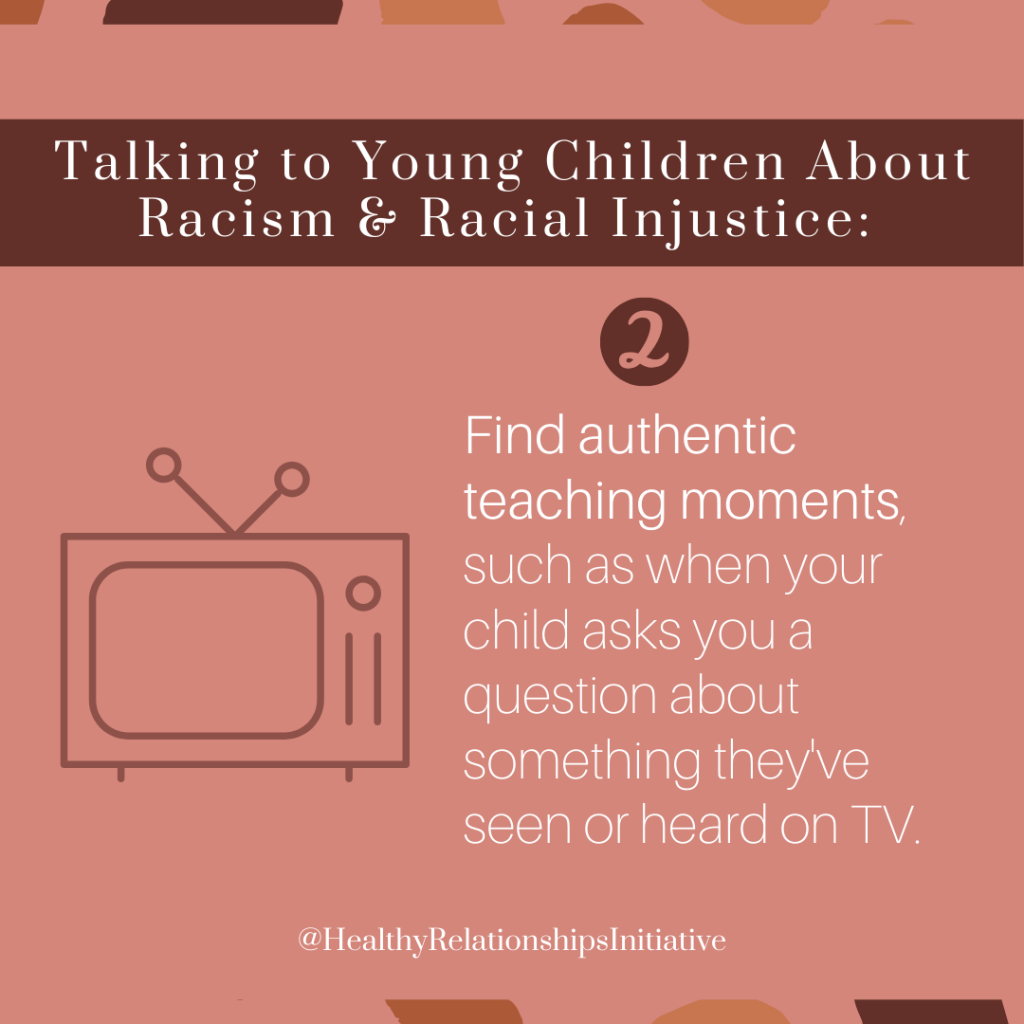
Talking to Young Children About Racism & Racial Injustice: Tip 2

Developed by HRI Program Coordinator, Camila Dos Santos, M.Ed.

Parents know that sometimes, the lessons that young children remember the most are the ones that begin from their own questioning or experiences.  

However, as parents, we can’t always wait for perfect moments to talk with our children, especially when the topic is one as crucial and urgent as racism and racial injustice.  Therefore, finding opportunities to talk about racism in an authentic way is crucial to raising children that become adults who understand and fight injustices of all kinds. 

If your child sees an interaction amongst adults that can prompt a discussion about injustices or inequality, use that moment to help your child understand what may have been done differently, or how a particular interaction can affect people differently.   If they ask a poignant question about something they’ve seen or heard on TV, use that opportunity to talk about what it means in a way that is developmentally appropriate for them.  

These conversations are not always easy to begin. It’s important to remember: “As parents and caregivers, we must have confidence in ourselves and in our children – that we, and they, can handle tough topics and tough situations.” (from PBS: https://www.pbs.org/parents/talking-about-racism

If you’re not sure where to start or how to approach the conversation about racism with your child or children, check out the following resources: 

Perhaps what is most important for parents to remember is that when they make the most of opportunities to teach young children important lessons, they are more likely to occur in a way that stays with their child long-term and impacts their future behavior. 

Talking to Young Children About Racism & Racial Injustice: Tip 1

Developed by HRI Program Coordinator, Camila Dos Santos, M.Ed.

Seeking to learn and understand personal biases can help parents model the behavior and actions they wish to see in their own children. 

A PBS resource for parents on talking to children about race states that being aware of your own bias is crucial as “really, what children pay attention to is adult behavior. They notice your body language. And they listen to what is being said around them.” (White, 2020).   Check out the PBS resource on How to Talk to Children Authentically About Racism here

We know that children learn from what adults do.  A good place to start when talking with young children about racism is to understand your own biases and how they can impact your own behavior.  These insights help to stay intentional about parenting and proactive about teaching young children to fight against injustices of all forms.

Natural Ebb & Flow to Friendships

“What I realize now in hindsight is that there is a natural ebb and flow to friendships. There are times you think there’s nothing left between you, that you’ve hit the bottom, but the special ones survive, find ways of restoring themselves.” – Colette McBeth in The Telegraph, July 2013

Adult friendships are complex and ever-changing. Friendships that are built on respect and communication are special and tend to find ways to survive the test of time.

For more on adult friendships, check out the following HRI resources:

A Healthy Teenage Summer: Tip 5

Developed by HRI Program Coordinator, Camila Dos Santos, M.Ed.

One way that parents can keep their teenagers healthy and safe this summer is to help them take on an important role or task within the household. Not only can this promote responsibility and accountability within their teens, it can help increase their sense of self-worth and confidence. 

When teenagers are granted responsibilities, they are more likely to feel as if their parents trust them and rely on them. This added trust from an adult can give teens more confidence in themselves and in their abilities. It is important to consider the age of your teenager when thinking about responsibilities that they can take on and to refrain from overloading them with too many tasks.  

Starting small and asking your teenager for their input will help ensure that your teenager does not get overwhelmed and that you do not create a situation that adds stress onto the family. Some responsibilities that teenagers can take on include helping their younger siblings with tasks, doing the grocery shopping, cooking one meal per week, or helping with yard work.  

Strengthen your relationship with your teen today by showing them that you trust them with an important task or responsibility. 


A Healthy Teenage Summer: Tip 4

Developed by HRI Program Coordinator, Camila Dos Santos, M.Ed.

One of the bigger myths about teenagers is that they don’t want to spend time with their parents.  Oftentimes, miscommunications and/or lack of time gets in the way of bonding with your teen, especially in one-on-one settings. But as plans change and vacations get postponed, this summer provides a unique opportunity for parents to bond with their teens.  

Whether there are activities that you’ve always done together, such as shopping or exercising, or whether you’d like to try something new, such as building something together, these moments provide meaningful opportunities to get to know your teen better, to connect over conversation, and importantly, to have fun together. 

Consider allowing your teenager to pick the activity or surprise them by doing something they’ve always wanted to do.  The more excited and invested they are in the activity, the more likely it is that the experience will be positive for the both of you. 

When parents and teenagers spend time together, it fosters a relationship with open and healthy communication.  When you add fun to the mix, it allows for creating meaningful memories together that set the foundation for a strong parent/teen relationship down the road.

A Healthy Teenage Summer: Tip 3

Developed by HRI Program Coordinator, Camila Dos Santos, M.Ed.

The pandemic has taught many of us that there are countless ways to stay connected without physically being together.  Helping your teenager stay connected to their circle this summer can provide a number of benefits, such as increased connection and happiness. 

Parents of teenagers know how important other social connections outside of the family are to their teens. When parents take the time to nurture and foster their teen’s relationships with others, it can help teens feel connected and less isolated. 

One way to keep your teen connected is to organize and host virtual meetings with their teammates if they play a sport, or with classmates and friends from school that they don’t see much over the summer. Having virtual meetings gives teens an opportunity to check in with one another, talk about how they’re coping and staying productive, and feel connected during a time when we aren’t seeing other people as often.  

Parents can play an important role in helping their teenagers foster healthy relationships outside of the home.  Spend some time focusing on keeping your teenager connected this summer and you may find that it improves your relationship overall!

A Healthy Teenage Summer: Tip 2

Developed by HRI Program Coordinator, Camila Dos Santos, M.Ed.

We’ve all heard by now how important self-care is if we want to live a life of emotional balance and reduced stress.  For many of us, however, implementing a consistent self-care routine is a challenge – especially when our routines are upended and uncertain. 

Parents can help their teenagers establish healthy relationship practices by working with them to establish a variety of self-care routines to promote their emotional balance and reduced stress.  And since the summer is typically a time of relaxation, this is a great time for teens to explore the self-care strategies that work for them without the pressure of an academic school-year and additional responsibilities that come along with it.  

Self-care requires trial and error, practice, and intentionality in order to work for us.  Some strategies to help your teen stay intentional and consistent about their self-care routine is to try new activities with them, encourage them to try new things, and involve them in your own self-care. 

HRI provides many resources for parents and teens to learn about and discuss self-care together,  including the following:

When we have multiple tools in our self-care toolbox, we are better prepared to deal with stress and emotional situations because we have a number of strategies that have already proven to work for us.  

By helping your teenager establish their own toolkit of self-care practices, they are more likely to be proactive in using these strategies when they need them the most. Working with your teen to establish healthy self-care practices will also increase the communication between you and your teen and give you an opportunity to bond over shared interests.

A Healthy Teenage Summer: Tip 1

Developed by HRI Program Coordinator, Camila Dos Santos, M.Ed.

For many teenagers, the summer is usually spent with loved ones and friends, but this summer may look a little different than most.  Increased time at home and decreased social interactions as a result of the pandemic means that most of us will be spending more time with our immediate family this summer. This gives parents of teenagers a unique opportunity to bond with them and learn about their perspectives. 

Parents can help teenagers have a happy and healthy summer by helping teens focus on strengthening their relationships and friendships during this time.  One way to do this is to talk intentionally with teens about what makes relationships healthy and happy and to also spend time discussing the signs of unhealthy relationships

The following HRI resources may be helpful in beginning these conversations with your teen: 

Asking your teenager questions about relationships will help you get a sense of their experiences and perspectives. Having this understanding of your teen will help you have healthy communication together and ensure you continue to have meaningful conversations in the future. 

When teenagers have the freedom to talk about their ideas, thoughts, and fears surrounding relationships with a trusted adult, they are more likely to examine their own relationships to ensure that they are happy, healthy, and safe – a skill that they will continue to use as they become adults. 

Stay tuned as we continue to share tips this week to help teens have a healthy summer!

Dr. John Gottman & Healthy Conflict

“In a good relationship, people get angry, but in a very different way. They see a problem a bit like a soccer ball… They kick it around. It’s “our problem.”  – Dr. John Gottman (Learn about him here.)

It is normal to experience conflict in relationships. People in healthy relationships, however, tend to work together to resolve conflict rather than placing blame or focusing on the negative.

Check out this HRI resource on Keeping Relationships Strong During Life’s Challenging Times for ways to work through relationship problems effectively and in a healthy way.