Showing appreciation is an important part of building healthy relationships and strengthening your connection with your partner! When you notice your partner doing something kind or thoughtful for you, praise them and show gratitude for their efforts. This will communicate to them that you notice the effort they are making to connect with you and strengthen your relationship.
Big emotions can be difficult to handle as adults. Now, imagine that you are experiencing really big, challenging emotions and also don’t know how to express or communicate them quite yet. This is often what is going on for young children when they experience temper tantrums or other forms of emotional expression that can be daunting for us as adults to help them manage.
As parents or other important adults in a child’s life, it’s important for us to be a force of calm when kids are experiencing these big emotions. When we show up in a way that is calm and caring, it will be easier for us to help the kids we care about calm down and begin to talk about what is going on. On the flip side, when we respond to children’s big emotions with our own chaos, it’s likely to make the situation worse. Remember, we’re more likely to respond with kindness and compassion when we are able to regulate our own emotions!
We know that it can be hard to keep your composure during difficult parenting moments. For more information about regaining your composure and staying calm during parenting challenges, check out one of our previous blog series!
Validation means recognizing and accepting your loved ones’ thoughts, feelings, and experiences. You don’t have to agree or even completely understand where someone is coming from to provide validation. Instead, validation communicates to others, “I see you, hear you, and accept you.” It conveys the powerful message of “I am here for you,” providing emotional security to the other person in the relationship.
Romantic relationships are exciting and complicated. Just like every person is unique, every relationship has its own quirks and pacing–basically its own life cycle. Maybe your relationship didn’t move through these stages in order, and that’s okay! Some couples become serious as soon as the first date finishes; some stay in the dating phase for years before making any commitments. Some relationships don’t even make it to a defining stage, but that doesn’t make them any less important!
It’s also okay if a relationship ends. Even years-long relationships can hit insurmountable obstacles, and that’s okay. It doesn’t mean the relationship is unimportant or a failure; sometimes people discover they aren’t compatible as partners, and this can happen at any stage. Be kind to yourself and your partner, even if things don’t work out. Breakups happen, and respect and honesty are just as much a part of a relationship’s end as its beginning!
Long-term relationships are wonderful; they bring a consistent source of support and affection, and provide a unique form of companionship different from other relationships. They are also a lot of work to maintain. Long-term partners are with us through major changes and life events: new jobs, lost loved ones, major illnesses, the list goes on! These situations bring with them a lot of emotions and changes–permanent and temporary–to the relationship dynamic. It’s important to be able to navigate these big commitments with healthy communication and respect. Now that you’re planning a future together, how are you working to ensure both your needs are met for careers, growth, and life goals? Are you able to navigate arguments with respect and compromise? Health in relationships doesn’t mean never disagreeing, but it does mean being able to discuss disagreements without name-calling, bringing up past arguments, or shutting each other out.
Long-term couples also share big responsibilities with one another. Sharing a house, getting married, or adopting a pet are permanent changes that don’t disappear with the end of a relationship. Have upfront and honest conversations about these commitments, and try to consider every possibility. What if one of you gets a job in a different city–will you keep the house and try long-distance, or move somewhere closer together? Discuss the finer details of the decisions as well: who will do the yard work, how much the dog will cost, how to raise the children. Long-term relationships require work and commitment, but if partners are honest and upfront with each other, they will be able to navigate any challenge with love and respect.
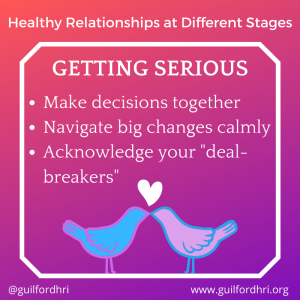
There comes a point in committed relationships where partners begin to consider their future as a couple. Often referred to as “getting serious,” this can be a period full of exciting firsts! Maybe this is when the first “I love you” is exchanged, or when you first meet each other’s families. This is also when partners begin making big decisions together. Communication is very important here! Things like navigating holiday schedules or traveling together for the first time bring new challenges to the relationship. We may be challenged to show parts of our lives or personalities to our partners that we haven’t before–how does the relationship dynamic hold up when not in “date mode?” Consideration for our partner may also begin to impact the decisions we make for ourselves. Do we take that promotion in a new city or move into that apartment across town when it might affect the relationship? Suddenly,decisions are a process between more than one person!
This is also a time to bring up big issues. Sometimes called “deal-breakers,” these are the things that are non-negotiable for you in a relationship. It’s important to see if you and your partner are on the same page about how you want your lives to look. Maybe one of you really wants kids, and the other really doesn’t. Maybe your political views differ on an issue that makes up a big part of your ethics or identity. As the relationship and your feelings grow more serious, it’s good to get these topics out in the open and determine if you and your partner are compatible. These can be uncomfortable discussions, but it is important to acknowledge, to both yourself and your partner, what you are unwilling to compromise on. Healthy relationships are not about changing each other or putting aside our goals and values. Rather, they are about sharing our life with someone who complements those goals and values. It’s best to determine if that compatibility is there before any major commitments are made.
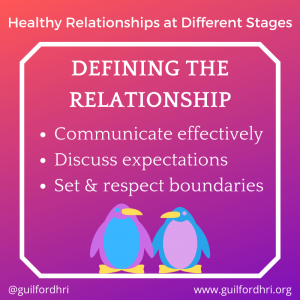
It’s an inevitable question in any romantic relationship: “What are we?” Defining the relationship can look like different things to different people. Maybe it’s becoming monogamous as a couple, using labels like “girlfriend” and “boyfriend,” or beginning to think of the relationship in the long term. Identifying what it means to each partner is a major step, and one that can be fraught with awkwardness and anxiety. It’s also the first point where many couples really test their ability to communicate. Communication is the cornerstone of any healthy relationship. Defining the relationship presents a space for partners to express what they want and need from a partnership. Are they on the same page, or is one partner looking for a long-term commitment while the other isn’t? Healthily handling these conversations with “I” language, empathy, and good listening skills make for a healthy dynamic, and bode good interactions later on down the road.
For many, defining the relationship also opens up conversations about boundaries. Say you and a partner have decided your relationship is committed. What are some things you are and aren’t willing to share (i.e. friends’ nights out, a key to your apartment, holiday visits to family)? While boundaries can change and expand overtime, this stage of the relationship is important for determining how respectful a partner is of your boundaries. Do they respect and work with those boundaries, or do they ignore and push at them? If boundaries are violated, talk about it, and if that kind of behavior persists, this might be a sign that the relationship isn’t healthy or compatible. Remember, respect should be part of relationships at every stage!
First starting to date someone is a rollercoaster of emotions! There’s excitement and attraction, but also uncertainty and doubt. Though it may not feel like a “relationship” just yet, it is still important to make sure the dynamic is healthy and respectful. Learn to recognize the difference between normal nerves and a legitimate concern. Do you get nervous butterflies, or genuinely dread the next date? Do you second guess yourself because you want to impress them, or because you fear what they’ll say? This is also the time to really get to know each other, which can feel like a lot of pressure. Though it can be hard, it’s important to be yourself! Talk about things that interest you, ask each other questions, and be honest about what you want. Honesty, communication, and openness are hallmarks of a good relationship, and it’s never too early to start applying these skills to a dynamic.
It’s also important to recognize potential red flags. How does the person you’re seeing treat others? If they abuse and berate waitstaff or talk poorly about their family and exes, this may reveal a pattern of disrespect in their relationships–something you don’t want to get mixed up in. Are they unnecessarily secretive? The biggest part of first dating is getting to know each other; refusing to answer basic questions about family or daily life may mean they have something to hide. Lastly, do you just get a bad feeling from this person? Our instincts are there for a reason, and sometimes they pick up on things we may not consciously notice. If something doesn’t feel right, it’s okay to break things off quickly. Remember, you are allowed to go at whatever pace you want, be that quick or slow. It’s your relationship, and it deserves to be comfortable, respectful, and above all, healthy!
We talk a lot about healthy relationships here at HRI! One type of relationship that often comes to mind is romantic ones. Romantic relationships are full of excitement and anxiety, and can also undergo a lot of change. People go from friends or strangers to intimate partners, sharing their emotions, living space, even children. Kindness and respect are important at every stage of a relationship, and that’s why HRI will be discussing Healthy Relationships at Different Stages. Join us this week on our blog or follow us @guilfordhri to learn more, and don’t forget to check out our upcoming content for Healthy Relationships Week in February (February 9th-15th)!